Bath stands as one of England's most architecturally complete Georgian cities, its honey-coloured terraces and Roman baths drawing more than six million visitors each year. The city's identity has been forged over two millennia by its thermal springs, its religious and social institutions, and the distinctive Bath stone that gives its streets their warm colour.
Roman Foundations and Sacred Waters
The site that became Bath was known to the Romans as Aquae Sulis, "the waters of Sulis", from around 60 AD. Archaeological evidence indicates that the hot springs were treated as a shrine by local Britons before the Roman invasion, dedicated to the goddess Sulis, whom the Romans identified with Minerva. The Romans constructed a temple between 60 and 70 AD, followed by a bathing complex that grew over the next three centuries to include a caldarium, tepidarium and frigidarium.
The baths fell into disrepair after the Roman withdrawal from Britain in the fifth century, but the springs never lost their reputation for healing. By the medieval period, the waters were again drawing visitors seeking relief from illness. In the seventeenth century, Thomas Guidott, a physician and chemist, published a treatise on the curative properties of Bath's waters, bringing the spa to national attention and laying the groundwork for the city's Georgian transformation.
Georgian Transformation: The Building of a Social Capital
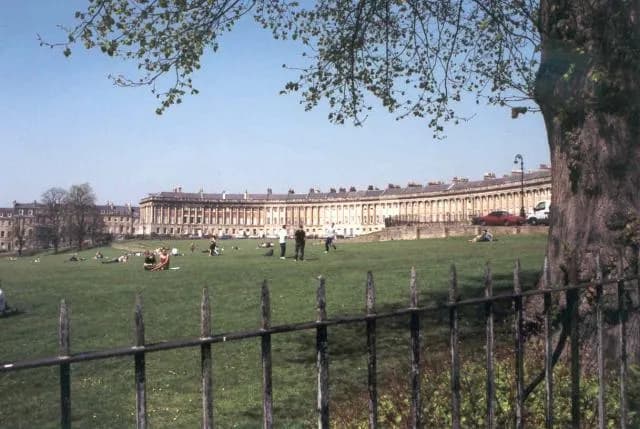
Bath's modern character was largely created during the eighteenth century, when it became Britain's pre-eminent spa town. Architects John Wood the Elder and his son John Wood the Younger reshaped the city with streets and squares of unprecedented regularity and grandeur. The elder Wood designed The Circus, a circular space of townhouses inspired by classical Roman architecture, while his son created the Royal Crescent, a sweeping terrace of thirty houses built between 1767 and 1774 that remains among the finest examples of Georgian architecture in the United Kingdom.
Much of the building was carried out in Bath stone, a creamy limestone quarried locally from Combe Down and Bathampton Down. The stone's warm colour became the visual signature of the city. Ralph Allen, who owned the quarries and held the contract for the postal service in western England, commissioned John Wood the Elder to build Prior Park as a showcase for the material.
The city's social life was governed by Beau Nash, who served as master of ceremonies from 1705 until his death in 1761. Nash established a code of behaviour for public entertainments and presided over the Assembly Rooms, where balls, concerts and card parties formed the centre of Bath's social season. The Pump Room, attached to the Roman Baths, provided a place for visitors to drink the mineral waters and to see and be seen.
Faith and Architecture: Bath Abbey
Bath Abbey, formally the Abbey Church of Saint Peter and Saint Paul, occupies a site of worship that dates to the seventh century, when Osric, King of the Hwicce, founded a monastery. The present building, constructed largely between 1499 and 1611, is a notable example of Perpendicular Gothic architecture and is particularly celebrated for its fan vaulting, designed by the masons Robert and William Vertue.
The abbey's west front features carvings of angels climbing stone ladders, a representation of Jacob's Ladder that, according to tradition, appeared in a dream to Oliver King, Bishop of Bath and Wells, in the late fifteenth century. The building was restored in the nineteenth century by Sir George Gilbert Scott and remains an active parish church, seating up to 1,200 people and hosting civic ceremonies, concerts and regular services.
Literary Footsteps: Jane Austen and Bath
Jane Austen lived in Bath between 1801 and 1806, and the city left a clear imprint on her work. Two of her novels, Northanger Abbey and Persuasion, are set partly in Bath, and both draw on the social rituals of the spa town: the promenades, the assemblies, the constant concern with rank and acquaintance. Austen's experience of Bath was not entirely happy; she is thought to have resented the move from her childhood home in Steventon, and her productivity as a writer declined during her years in the city. Nevertheless, her sharp observations of Bath society have preserved the texture of the place for later generations.
Modern Bath: Education, Sport and Contemporary Life
Today Bath is home to two universities, the University of Bath and Bath Spa University, together with Bath College, which gives the city a substantial student population and a continued connection to learning and the arts. The city's sporting life is anchored by Bath Rugby, one of England's most prominent rugby union clubs, and Bath City Football Club.
Bath received UNESCO World Heritage Site status in 1987, recognising the exceptional preservation of its Georgian streetscape and its Roman archaeological remains. In 2021 it was added to the transnational World Heritage Site known as the Great Spa Towns of Europe, alongside spa towns in Belgium, Germany, France and other countries. The designation reflects not only the historical importance of the waters but also the city's success in preserving the architectural and social heritage that grew up around them.
The Roman Baths themselves remain one of the best-preserved Roman bathing complexes in northern Europe, receiving more than one million visitors annually. Although bathing in the ancient pools is no longer permitted, the nearby Thermae Bath Spa allows modern visitors to experience the thermal waters in a contemporary setting, including a rooftop pool with views across the city.
Bath's compact centre, its pedestrian-friendly streets, and its concentration of museums, galleries and independent shops continue to make it a destination for residents and visitors alike. The city that the Romans called Aquae Sulis, and that the Georgians made a capital of fashion, remains defined by the water that rises from the ground at 46 degrees Celsius, just as it has for nearly two thousand years.